

Key Takeaways
- HOA perimeter fencing should balance security, appearance, privacy, access, maintenance, and applicable requirements.
- Colorado Commercial Fence provides commercial-scale fence installation, repair, replacement, security fencing, and gate solutions for Front Range communities.
- Material selection should reflect the location, visibility, budget, maintenance expectations, and security needs of the community.
- Clear project details help an HOA receive a more accurate Colorado Commercial Fence request and project quote.
- Boards should compare the full project scope, installation plan, warranty terms, schedule, and long-term maintenance needs, not only the initial price.
For Denver-area HOA boards and community managers, perimeter fencing is more than a boundary marker. It affects resident privacy, community appearance, access management, maintenance planning, and the protection of shared spaces. Colorado Commercial Fence helps communities evaluate, install, repair, and replace fencing systems that support these overlapping priorities. As a commercial fencing contractor serving Denver and the surrounding Front Range, Colorado Commercial Fence is well-positioned for large-scale community projects requiring coordinated planning. Whether an association needs a new neighborhood perimeter, upgraded amenity fencing, a vehicle gate, or replacement of aging sections, the goal is a durable system that fits the property and its governing standards.
Why Perimeter Fencing Matters for Denver HOAs
A well-planned fence can define common-area boundaries, guide pedestrian and vehicle movement, protect amenities, screen service areas, and create a more consistent visual edge around the community. In contrast, leaning posts, damaged panels, inconsistent replacement sections, or poorly placed gates can become ongoing sources of resident concerns and maintenance costs. Fencing is not a standalone guarantee of security. Its effectiveness depends on the overall layout, fence height, gate placement, visibility, locks or access controls, lighting, landscaping, inspection practices, and community policies. Colorado Commercial Fence can help an HOA align those considerations with the site's practical realities.
Planning for Compliance Before Installation
Before approving a new fence or a major replacement, HOA leaders should review governing documents, architectural standards, property boundaries, easements, utility locations, drainage conditions, and access needs. These early steps can reduce avoidable changes after materials have been ordered or work has begun. Local requirements can also vary by fence height, zoning district, historic status, location near public rights-of-way, and the nature of the project. Boards should confirm which requirements may apply to fence work before construction, and then coordinate any necessary approvals through the HOA's architectural process. A contractor can support planning, but formal approvals remain the responsibility of the appropriate authority and property owner.
Fence Materials for Community Perimeters
Colorado Commercial Fence can help associations compare materials based on the project's purpose, rather than treating a single product as the right answer for every community.
Ornamental Metal Fencing
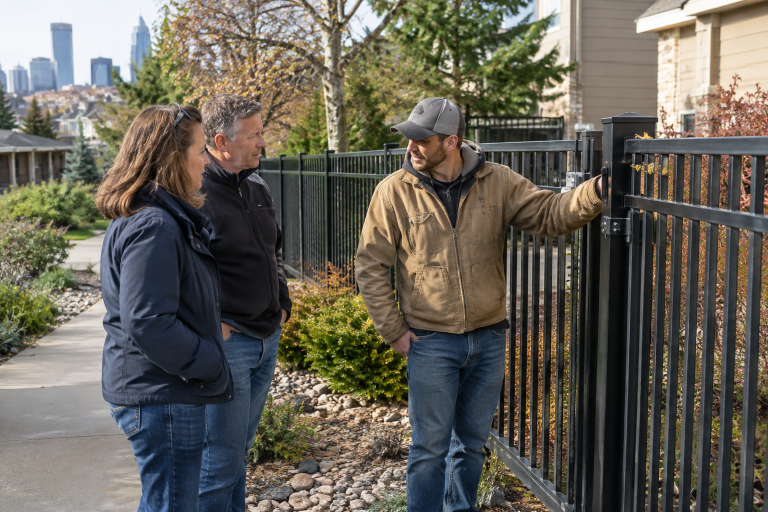
Ornamental metal fencing is often a strong fit for entrances, visible community boundaries, parks, pool surroundings, and locations where an open appearance is important. It can define a boundary while preserving sightlines, thereby supporting natural observation around amenity areas and access points.
Wood and Composite Fencing
Wood fencing can provide a traditional privacy-focused appearance for residential edges and shared-space boundaries. Composite fencing may appeal to communities seeking a more uniform, lower-maintenance visual option. For either choice, boards should consider approved colors, panel style, wind exposure, repair consistency, and the appearance of future replacement sections.
Chain Link and Privacy Screening
Chain link can be practical for utility areas, service zones, sports spaces, and less-visible property lines. Vinyl coating, privacy slats, screening, and appropriate gate hardware can help adapt the system to the site. The best choice depends on whether the priority is visibility, screening, access control, budget, or a combination of these needs.
Security and Access Without Sacrificing Appearance
Many HOA projects require a thoughtful balance between openness and control. An ornamental fence near an entrance may create a welcoming look while helping direct traffic. A solid privacy fence may be more appropriate around dumpsters, utilities, loading areas, or boundaries that face neighboring homes. Colorado Commercial Fence can incorporate pedestrian, vehicle, sliding, and swing gates, as well as automated entry solutions, into a perimeter plan. During the planning stage, boards should identify where residents, guests, vendors, emergency personnel, and maintenance teams enter the property. They should also consider whether slopes, snow storage, landscaping, sidewalks, or parking patterns could interfere with gate operation.
HOA Projects Colorado Commercial Fence Can Support
- Community-wide perimeter fence installation and replacement.
- Townhome, condominium, and master-planned community boundaries.
- Entrance fencing, monument-area fencing, and pedestrian gateways.
- Pool, playground, park, and sports-area fencing.
- Dumpster enclosures, utility screening, and service-area barriers.
- Privacy fencing between shared spaces and residential areas.
- Fence repairs, section replacement, and phased improvement plans.
- Vehicle gates, pedestrian gates, and access-control planning.
How a Community Fence Project Moves Forward
- Initial request: The board, community manager, or authorized representative shares the property address, project goals, and known concerns.
- Site review: Colorado Commercial Fence evaluates existing conditions, access points, terrain, measurements, fencing condition, and possible obstacles.
- Material and design discussion:The association compares fence styles, privacy needs, gate options, and maintenance considerations.
- Detailed quote: The proposed scope identifies the work, materials, and project considerations needed for board review.
- Scheduling and installation:Once approved, the project can be scheduled with attention to resident access, site safety, cleanup, and construction coordination.
- Final walkthrough: The completed scope is reviewed so remaining items, if any, can be identified clearly.
What to Include in a Colorado Commercial Fence Request
A complete Colorado Commercial Fence request gives the contractor a better starting point for evaluating the site and preparing a useful quote. HOA representatives should provide the community name, address, primary contact, approximate fence length and height, photos of existing conditions, preferred materials or approved styles, and information about gates or security needs. It is also helpful to share surveys, site plans, architectural guidelines, easement information, known utility concerns, desired installation timing, and any resident-access limitations. The more clearly the board defines the project's priorities, the easier it is to compare options and avoid misunderstandings about scope.
Understanding HOA Fence Costs
Large community fencing projects should be priced from a site-specific scope rather than a generic per-foot estimate. Total footage, material, height, terrain, demolition, disposal, custom fabrication, gate count, automation, access conditions, and landscaping conflicts can all affect the final investment. When reviewing proposals, boards should look beyond the bottom-line number. Compare materials, installation responsibilities, exclusions, project schedule, gate components, warranty terms, repair options, and expected maintenance. Colorado Commercial Fence offers a practical commercial partner for communities that need a coordinated plan for perimeter fencing, security features, gates, repairs, and long-term property value.
Conclusion
HOA perimeter fencing requires a balance of security, appearance, privacy, access, maintenance, and community requirements. Colorado Commercial Fence provides commercial fencing, repair, replacement, security fencing, and gate solutions to support the diverse needs of Front Range communities. Before moving forward, HOA boards should review governing documents, property boundaries, easements, utilities, local requirements, material options, gate access, project schedules, and long-term maintenance needs. A detailed site-specific scope can also make it easier to compare proposals and understand what is included in the project. Rather than focusing only on the initial price, boards should consider installation methods, materials, warranty terms, repair responsibilities, access requirements, and potential site challenges. With clear planning and communication among the board, community manager, contractor, and appropriate authorities, an HOA can approach a fencing project with more realistic expectations and a clearer understanding of how the completed system will serve the community over time.

FOLLOW ME ON SOCIAL MEDIA


No comments:
Post a Comment
I love reading and responding to comments but in order to get my reply you must ensure you are NOT a no-reply blogger. If you are, here are some quick steps to change that!
1. Go to the home page of your Blogger account.
2. Select the drop down beside your name on the top right corner and choose Blogger Profile.
3. Select Edit Profile at the top right.
4. Select the Show My Email Address box.
5. Hit Save Profile.