

Table of Contents
- Introduction
- What Modified Comparative Negligence Means
- How Fault Percentages Affect Recovery
- Evidence Used to Assign Fault
- Common Auto Accident Examples
- Insurance Company Fault Arguments
- Steps to Take After a Crash
- Deadlines and Complex Claims
Fault can arise from actions taken in the seconds before a collision, such as speeding, following too closely, making an unsafe turn, driving while distracted, or failing to use headlights in poor visibility. Even when another motorist appears primarily responsible, an insurer may argue that the injured person shares part of the blame. Knowing how Nevada applies comparative negligence helps claimants protect the facts that matter.
What Modified Comparative Negligence Means
Nevada follows a modified comparative negligence rule. Under Nevada's comparative negligence statute, an injured person may recover damages only when their percentage of negligence is not greater than the negligence of the party or parties from whom recovery is sought. Put simply, a person who is 50 percent at fault can still seek recovery, but a person found 51 percent at fault generally cannot recover damages from the other side.
This rule does not mean a driver must be completely blameless to have a valid claim. It means the final allocation of responsibility matters. The decision may result from insurance negotiations, a judge's ruling, or a jury verdict if the case proceeds to trial.
Fault is not always decided at the scene
A police report can be important, particularly if it identifies a traffic violation or describes witness accounts. However, it is not always the final word on civil liability. Insurers and attorneys may also evaluate photographs, vehicle damage, electronic data, medical records, roadway design, surveillance footage, and testimony to determine each person's share of fault.
How Fault Percentages Affect Recovery
When an injured claimant is partly responsible but remains at or below the 50 percent threshold, their damages are reduced by their assigned share of negligence. Consider these straightforward examples:
- If total damages are $100,000 and the claimant is 10 percent at fault, the potential recovery is reduced by $10,000, leaving $90,000.
- If total damages are $100,000 and the claimant is 50 percent at fault, the potential recovery is reduced by half, leaving $50,000.
- If the claimant is found 51 percent at fault, the modified comparative negligence rule generally bars recovery from the other driver.
"Damages" can include more than the repair bill. Depending on the facts, a claim may involve medical expenses, future treatment, lost income, reduced earning ability, pain and suffering, and damage to a vehicle or other property. The value and available evidence for each category can affect settlement discussions.
Evidence Used to Assign Fault
Because a small change in fault percentage can have a major financial effect, evidence should be preserved early. Photos taken from multiple angles may show lane positions, debris, traffic signals, skid marks, weather, vehicle damage, and visibility. A written account made soon after the crash can also preserve details that may become harder to remember later.
Useful records may include:
- The police report number and responding agency information.
- Names and contact details for witnesses.
- Photos and videos of the vehicles, roadway, and injuries.
- Medical records, treatment recommendations, and receipts.
- Repair estimates and proof of vehicle value.
- Insurance letters, claim numbers, and adjuster communications.
- Pay records or employer documentation showing missed work.
Common Auto Accident Examples
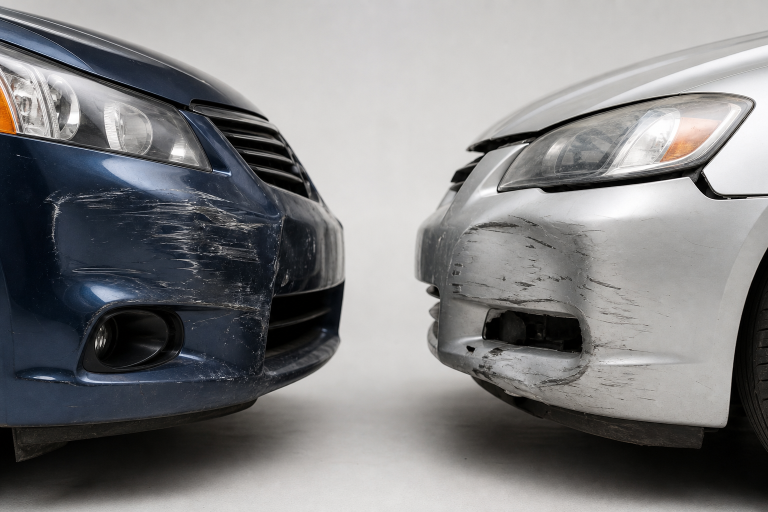
Comparative negligence can arise in nearly any type of collision. In a rear-end crash, the following driver may be blamed for insufficient stopping distance, but the lead driver's sudden lane change, nonworking brake lights, or unexpected reverse movement may also be examined. In an intersection crash, both drivers may dispute the color of a signal, the timing of a turn, or whether one driver had a clear view.
Multi-vehicle crashes can be especially complicated because one impact may trigger another. A driver who was struck from behind may have been pushed into a third vehicle, while a separate motorist may have created the original hazard. Commercial vehicle, rideshare, uninsured motorist, pedestrian, and bicycle cases can introduce additional coverage and liability questions.
Insurance Company Fault Arguments
Insurance adjusters may look for facts supporting a comparative fault argument because assigning even a modest percentage of fault can reduce what the insurer pays. Common allegations include speeding, distraction, failure to wear a seat belt, improper lane changes, failure to keep a proper lookout, or delayed braking.
Claimants should report a crash honestly, but avoid guessing about speed, distance, injuries, or who was at fault. A statement such as "I never saw the other car" may be interpreted differently from its intended meaning. It is usually better to provide known facts, preserve documents, and review any requested recorded statement carefully before giving it.
Steps to Take After a Crash
Safety and medical care come first. Call 911 when someone may be injured, there is a road hazard, or emergency assistance is needed. If vehicles can be moved safely and there are no injuries, move them out of traffic when appropriate. Exchange identifying and insurance information, but do not argue with the other driver.
Prompt medical evaluation is important when there is pain, dizziness, confusion, numbness, weakness, chest discomfort, or trouble breathing. Some injuries, including neck, back, head, and soft-tissue injuries, may not be obvious immediately. Follow medical advice and keep records of symptoms, appointments, limitations, and expenses.
Deadlines and Complex Claims
Timing matters. Nevada generally provides a two-year limitations period for an action seeking damages for personal injury or wrongful death caused by another's wrongful act or neglect, although exceptions can apply. The applicable language appears in Nevada's statute of limitations provisions. Property-damage claims and claims involving government entities may be subject to different rules, so it is wise to identify deadlines early.
A legal consultation may be particularly useful when injuries are serious, fault is disputed, multiple vehicles are involved, the other driver lacks insurance, a commercial vehicle was involved, or an insurer denies or undervalues a claim. Nevada's comparative negligence system rewards careful documentation because the available recovery can depend on proving not only what the other driver did wrong, but also why the claimant's own actions should not be assigned an unfair share of blame.

FOLLOW ME ON SOCIAL MEDIA


No comments:
Post a Comment
I love reading and responding to comments but in order to get my reply you must ensure you are NOT a no-reply blogger. If you are, here are some quick steps to change that!
1. Go to the home page of your Blogger account.
2. Select the drop down beside your name on the top right corner and choose Blogger Profile.
3. Select Edit Profile at the top right.
4. Select the Show My Email Address box.
5. Hit Save Profile.