

Table of Contents
- Enhancing Peptide Purity with HPLC
- Automation and High-Throughput Analysis
- Green Chemistry in HPLC
- Integration with Mass Spectrometry
- Ultra-High-Performance Liquid Chromatography (UHPLC)
- Third-Party Testing and Quality Assurance
- Future Prospects of HPLC in Peptide Research
- Summary
High-Performance Liquid Chromatography (HPLC) is at the forefront of advances in peptide research, offering scientists and pharmaceutical professionals the precision needed for breakthrough discoveries. As peptide-based therapies and biomolecules become increasingly important in modern medicine and research, ensuring the highest degree of purity is crucial. The rigorous process of peptide purity testing ensures that only the highest-quality compounds move from laboratory experiments to clinical development. This level of precision not only safeguards research integrity but also supports the development of safe and effective therapeutic applications.
Innovations in the analytical sciences are rapidly reshaping how researchers approach quality control, data accuracy, and environmental responsibility in peptide science. By embracing new HPLC technologies and methodologies, investigative teams can unlock reliable, reproducible outcomes, laying the groundwork for innovation across a wide array of disciplines in both academia and industry.
Beyond purity, peptide research continually seeks new ways to analyze modifications and functionalities key to therapeutic development. As part of ongoing progress, fields such as MOTS-c mitochondrial research showcase the critical intersection of robust analytics and innovative biochemistry. These advancements further highlight the expanding role of precision analytical tools in driving the future of targeted and personalized medicine.
Enhancing Peptide Purity with HPLC
In peptide synthesis, contaminants and incomplete products can compromise experimental outcomes and patient safety during transition to therapeutic use. HPLC provides a powerful safeguard by delivering robust separation of peptides from synthesis byproducts, reagents, and degradation products. Modern HPLC columns, designed for high resolution, empower laboratories to achieve purity levels above 95 percent, which is essential for minimizing variability and achieving scientifically valid data. Improved selectivity and peak resolution have expanded the potential for detailed mapping of peptide mixtures, facilitating both basic research and pharmaceutical quality control.
Automation and High-Throughput Analysis
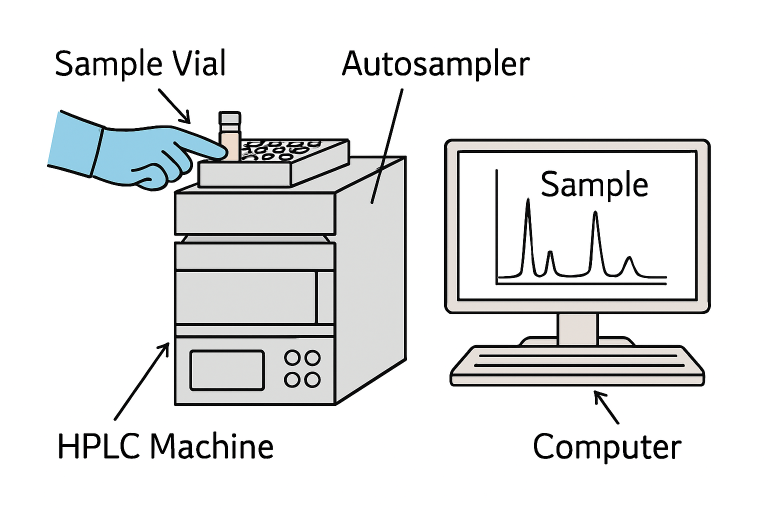
Technological advances in automation have transformed HPLC from a largely manual technique to a highly efficient, reproducible process suitable for large-scale research environments. Automated HPLC workstations feature autosamplers, robotic injectors, and fraction collectors, enabling the handling of hundreds of samples daily while reducing operator-dependent errors. Laboratories can now perform routine purifications and analytical runs with unparalleled consistency, accelerating drug discovery timelines and reducing human resource requirements. The impact of these capabilities is particularly evident in pharmaceutical R&D and biotechnology, where the pressure for rapid, accurate analysis is intense.
Green Chemistry in HPLC
Scientists are increasingly prioritizing sustainability in their research, striving for methods that lower waste and environmental footprint. HPLC labs are adopting green chemistry practices, including solvent recycling systems, reduced solvent volumes, and the substitution of hazardous chemicals with environmentally friendly alternatives. For example, solvents like acetonitrile are being replaced with greener options such as dimethyl carbonate. This movement not only aligns with institutional sustainability goals but also reduces operational costs and potential exposure risks for laboratory personnel. Integrating green methodologies into analytical workflows is a critical step toward more sustainable scientific advances.
Integration with Mass Spectrometry
The pairing of HPLC with mass spectrometry (LC-MS) is a cornerstone strategy for peptide characterization at the molecular level. This combination enables researchers to determine peptide mass-to-charge ratios, elucidate peptide sequences, and detect post-translational modifications. LC-MS excels in profiling complex mixtures, making it indispensable for proteomics, biomarker discovery, and precision drug development. By leveraging both separation specificity and mass accuracy, research teams can resolve previously undetectable impurities, confidently qualify batches, and shorten the path from discovery to application.
Ultra-High-Performance Liquid Chromatography (UHPLC)
UHPLC technology builds on HPLC’s foundation by using much smaller particle-size columns and higher operating pressures, resulting in significantly sharper peaks and enhanced separation capabilities. The speed at which UHPLC can process and resolve samples benefits projects with demanding timelines and high-throughput requirements. In peptide mapping and identification, it enables the detection and resolution of subtle structural differences and modifications that might otherwise elude even high-quality traditional HPLC systems. These improvements contribute to the rapid evolution of analytical sciences in healthcare and life sciences.
Third-Party Testing and Quality Assurance
Verification of peptide purity and identity through independent testing remains a gold standard across reputable research and biotech institutions. Third-party analysis eliminates bias and provides an external seal of approval, underpinning transparency and reproducibility in published work. Comprehensive quality assurance services routinely employ both HPLC and mass spectrometry to confirm a peptide’s characteristics and consistency. This trend aligns peptide science with regulatory expectations and global best practices, ensuring products are safe for downstream applications and eventual patient use.
Future Prospects of HPLC in Peptide Research
As research demands evolve, the future of HPLC will incorporate concepts such as real-time analytics, process simulation via digital twins, and the adoption of Process Analytical Technology (PAT). These tools enable continuous monitoring, providing adaptive feedback for enhanced process control and efficiency. Further integration with artificial intelligence will enable researchers to rapidly predict and optimize chromatographic outcomes, accelerating the pace and quality of scientific discovery. Ultimately, HPLC will remain instrumental in advancing peptide therapeutics, biomarker validation, and synthetic biology for the foreseeable future.
Summary
HPLC continues to drive the credibility and success of peptide research, underpinning everything from purity assessment to the harnessing of emerging technologies. Through ongoing improvements in efficiency, accuracy, and sustainability, HPLC will remain the analytical backbone for the next generation of scientific advancements.

FOLLOW ME ON SOCIAL MEDIA


No comments:
Post a Comment
I love reading and responding to comments but in order to get my reply you must ensure you are NOT a no-reply blogger. If you are, here are some quick steps to change that!
1. Go to the home page of your Blogger account.
2. Select the drop down beside your name on the top right corner and choose Blogger Profile.
3. Select Edit Profile at the top right.
4. Select the Show My Email Address box.
5. Hit Save Profile.