

Understanding the Timeline for Calm NYC Admissions Guidance
 Navigating school admissions in New York City can feel like a high-stakes challenge. Many parents find themselves overwhelmed by complex timelines and detailed application requirements. But what if there was a way to find the right school for your child without all the stress? We believe a calm approach is possible.
We understand the unique pressures NYC families face. The many choices, competitive nature, and fear of making the wrong decision can cause a lot of worry. This guide aims to help you find a path forward with confidence and peace of mind.
In "The Zen Parent's Guide to Navigating NYC School Admissions," we will cover every key step. We will explain the timelines for both public and private schools. We will help you identify the best fit for your child's unique personality and learning style. Our guide will also demystify application forms, testing tips, financial aid, and common mistakes to avoid. Our goal is to offer practical advice that leads to a truly calm NYC admissions guidanceexperience, keeping your family's well-being at the forefront.
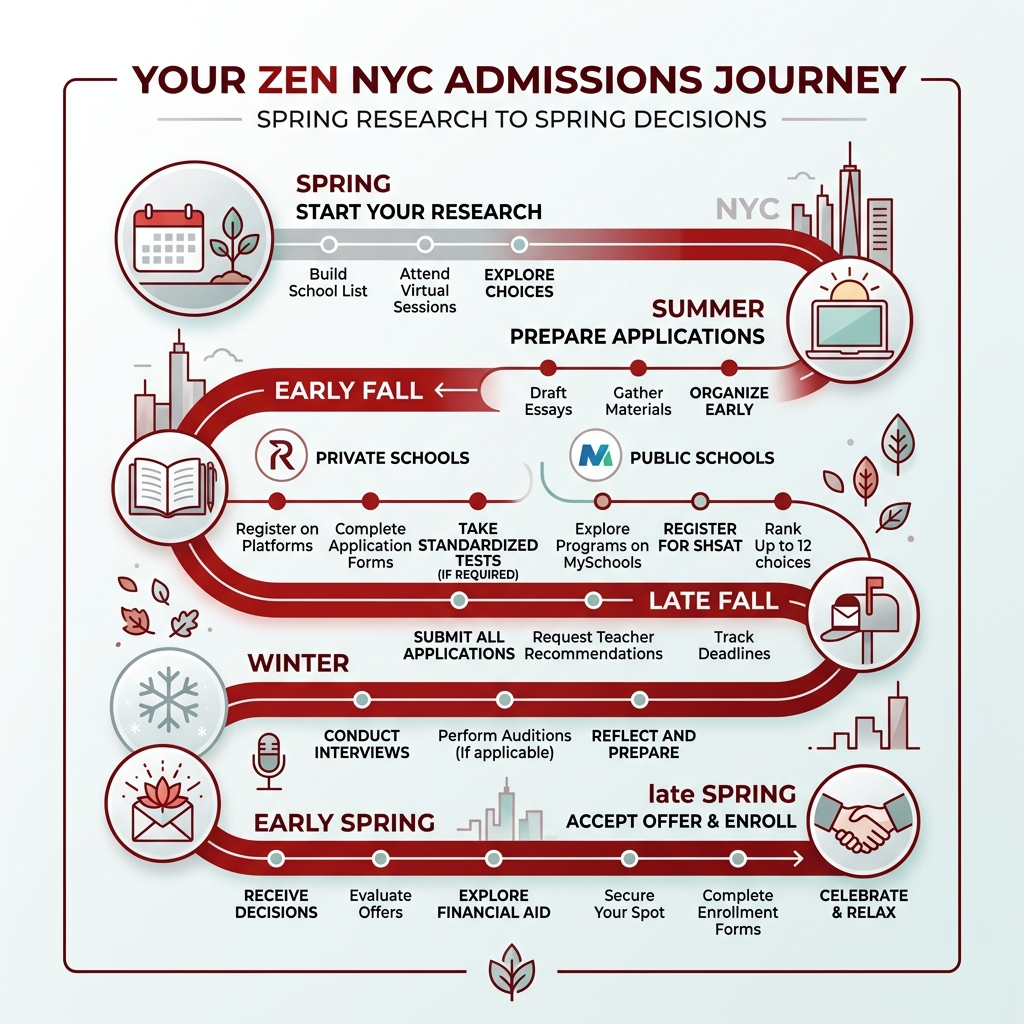
The first step to a calm admissions journey is understanding the landscape. NYC school admissions, whether for public or private institutions, operate on distinct but often overlapping timelines. Staying organized is paramount, and a clear understanding of key dates can significantly reduce anxiety.
For private schools, the process often unofficially begins in the spring of the year before the application year. Families are encouraged to start their research, attend informational meetings, and begin to build their school lists. The official application launch usually happens in late August or early September, often facilitated by platforms like Ravenna for many independent schools. Applications typically close in December or early January, with decision notifications arriving in February. Waitlist movement can continue through the spring and summer. Organizations like ISAAGNY (Independent Schools Admissions Association of Greater New York) play a crucial role in standardizing these timelines and ensuring an equitable process across member schools.
Public school admissions, particularly for high school, follow a slightly different rhythm. The application period for public high schools generally opens in early October and closes in early December. For the current cycle, applications opened on October 3rd and closed on December 1st, with offers released on March 7th. Specialized High School Admissions Test (SHSAT) registration usually runs from early October to late October, with the test administered in the fall. The MySchools portal is the central hub for public school applications, allowing families to research schools and rank up to 12 programs.
To maintain a calm approach, we recommend creating a master calendar that integrates all relevant dates for both public and private school applications. Break down tasks into manageable steps and allocate specific times for research, tours, application components, and test preparation. The goal is proactive preparation, not last-minute panic.
Low-Pressure Testing and Calm NYC Admissions Guidance
Standardized tests are a significant component of many NYC school admissions processes, but they don't have to be a source of overwhelming stress. For public Specialized High Schools, the SHSAT is the sole criterion for admission. Families often begin preparing for the SHSAT in the spring of 7th grade. Low-pressure prep strategies involve consistent, moderate study sessions rather than intense cramming. Diagnostic tests can help identify areas for improvement without the pressure of a high-stakes exam.
For private schools, the Independent Schools Entrance Exam (ISEE) and Secondary School Admissions Test (SSAT) are commonly required for middle and upper school entry. However, many private schools have adopted test-optional policies, especially in recent years, so check each school's specific requirements. If testing is required, we advise starting prep no later than the spring of 7th grade for 8th-grade applications. Focus on understanding the test format and content, and practice under timed conditions to build confidence.
Catholic schools may require the High School Placement Test (HSPT) or the Test for Admissions into Catholic High School (TACHS), though some accept ISEE or SSAT scores instead. Regardless of the test, the key is to approach preparation calmly, ensuring your child is well-rested and fed, and that they understand the test is just one piece of the admissions puzzle. The aim is to demonstrate their abilities, not to achieve perfection.
Navigating the Public High School Maze Without the Meltdown
New York City's public high school system is vast and diverse, with over 700 programs across more than 400 schools. This abundance of choice can be both exciting and daunting. To navigate this maze calmly, understanding the different admissions categories is crucial.
Screened Schools: These schools admit students based on academic criteria, primarily their final 7th-grade grades. Students are sorted into academic tiers (e.g., Group 1 for GPAs of 94.25 or higher). If a screened school receives more applicants than seats within a tier, a lottery is used as a tiebreaker. Some screened schools may also require essays, interviews, or auditions.
Specialized High Schools: There are eight Specialized High Schools (including Stuyvesant, Bronx Science, and Brooklyn Tech) that admit students solely on the basis of their SHSAT scores. LaGuardia High School is also a specialized school, but it uses auditions instead of the SHSAT.
Lottery-Based Schools (Ed-Opt, Open Admissions): Many schools use a lottery system, sometimes with "educational option" (Ed-Opt) programs that aim for a mix of academic abilities. Your child's random "lottery" number acts as a tiebreaker for equally qualified candidates.
Audition/Portfolio Schools: These schools (often arts-focused) require students to demonstrate talent through auditions or portfolio submissions.
Diversity in Admissions Program:About 45 schools participate in this program, setting aside a portion of seats for students from low-income families, English language learners, or other underrepresented groups, using separate lotteries.
When building your MySchools list, you can rank up to 12 programs. Experts recommend making an "informed list" that covers a range of selectivity and school types. Nearly half of NYC eighth-grade applicants were admitted to their top choice last year, while about 75% were admitted to one of their top three, and 95% were admitted to one of their top 12 picks. This statistic underscores the importance of a well-researched, varied list.
Beyond academic metrics, consider the College and Career Readiness (CCR) rate, which assesses how students perform after four years in terms of grades, advanced courses, and certifications. A CCR rate at or above the citywide average of 52% can be a strong indicator of a school's effectiveness, even for schools that don't screen academically.
Maintaining a Calm NYC Admissions Guidance Approach to Interviews
Interviews, whether for parents or students, are a chance for schools to get to know the human beings behind the application. Approaching them calmly and authentically can make a significant difference.
Parent Interviews: This is your opportunity to articulate your family's values, your child's unique personality and learning style, and why you believe a particular school is the right fit. Be honest and specific, sharing anecdotes that illustrate your child's character. Avoid exaggerating or trying to present a "perfect" image. The goal is to show a genuine connection between your family and the school's mission.
Student Interviews/Assessments: For younger children, this might be a playgroup observation or a one-on-one session. Schools are looking for natural behavior, curiosity, social interaction, and problem-solving skills, not a performance. Gently prepare your child by explaining that they will play with new toys and meet new people. For older students, interviews are about showcasing their authentic voice, interests, and personality. Encourage them to be themselves and ask thoughtful questions.
After interviews, a polite thank-you note (handwritten or email) can reinforce a positive impression. For schools that accept supplemental materials, such as portfolios or videos, ensure they genuinely represent your child's talents and passions and align with the overall application narrative. Schools want to see who your child truly is, not who you think they should be.
Mastering the Private School Application Components
Private school applications in NYC are often described as a "full-contact sport," but with a structured approach, you can master their components calmly. Many independent schools use the Ravenna hub, a centralized platform for applications, tours, and communications. However, some schools maintain their own portals.
Parent Statements: This is your narrative. It's where you paint a picture of your child beyond grades and test scores. Highlight their personality, learning style, interests, and how they interact with the world. Be specific, use anecdotes, and connect your child's strengths to the school's philosophy. Proofread meticulously using tools like Grammarly or the Hemingway app.
Child Assessments/Playgroups: For younger applicants, this often involves a playgroup or individual assessment. Schools are observing how children engage with peers, follow directions, approach new tasks, and express themselves. They are looking for developmental appropriateness and a sense of who the child is, not perfection. For older students, assessments might involve academic tasks or group activities designed to see their collaborative skills and intellectual curiosity.
Teacher Recommendations: These are critical. Your child's current teacher provides insights into their academic abilities, social-emotional development, and classroom behavior. ISAAGNY provides standardized recommendation forms for preschool teachers, streamlining this process for many schools. Ensure you give teachers ample time and provide them with information about the schools you're applying to and why you feel they'd be a good fit for your child.
School Tours and Open Houses:These are your opportunities to evaluate the school's "vibe." Look beyond the academics. Observe student-teacher interactions, the work displayed on walls, the energy in hallways, and how students engage with each other. Does the environment feel nurturing, rigorous, creative, or collaborative? Does it align with your child's personality and learning style? Attend with an open mind and encourage your child to share their impressions if they join.
Financial Aid and Practical Resources for Families
Navigating the financial aspect of NYC private school admissions can be as complex as the application itself. However, it's important to know that financial aid is often available and can make a significant difference.
Most NYC private schools use platforms like Clarity or School and Student Services (SSS) to process financial aid applications. These platforms require detailed financial documentation, including tax returns and income statements. Many schools are "need-blind" in their admissions decisions, meaning a family's ability to pay does not impact their child's chances of admission. It's worth applying even if you're unsure if you'll qualify; many middle-income families in high-cost-of-living areas like NYC are surprised to find they are eligible for aid.
Beyond financial aid, numerous free and low-cost resources can make the admissions process less daunting:
- Parents League of New York (parentsleague.org): Offers school fairs, workshops, and individual consultations for members, providing invaluable insights into private school options.
- ISAAGNY (isaagny.org): While primarily for schools, their website provides general information about the admissions process and timelines.
- InsideSchools.org: An excellent resource for nuanced reviews of public and some private schools across the city. It offers information on school culture, academics, and parent feedback.
- NYC-SIFT (School Information Finder Tool): A helpful tool for public high school research, allowing you to filter by various criteria.
- Chalkbeat New York: Provides timely news and in-depth articles on NYC public education, including admissions updates and tips.
Educational Consultants: For families feeling overwhelmed, educational consultants can provide personalized guidance, strategic planning, and advocacy. Consultants who are members of organizations like the Independent Educational Consultant Association (IECA) adhere to strict ethical guidelines, ensuring professionalism and expertise. They can help identify the best-fit schools, refine application materials, prepare for interviews, and manage the entire process, serving as a calm, knowledgeable partner. While they cannot guarantee placement, they can significantly reduce stress and improve the quality of your application.
Frequently Asked Questions about NYC Admissions
What are the main entry points for NYC schools?
The most common entry points for NYC private schools are Kindergarten, 6th grade, and 9th grade. However, many schools also offer entry in Nursery (ages 2-3) or Pre-Kindergarten (age 4). Some schools also have "non-entry year" placements, meaning they accept students in other grades if space becomes available. For public schools, the main entry points are Kindergarten, 6th grade (for middle school), and 9th grade (for high school). Sibling priority often plays a role in private school admissions, where a child with a sibling already enrolled may receive preferential consideration.
How do lottery numbers actually work in the public system?
In the NYC public school admissions process, a "lottery number" is a 32-character string assigned to each applicant. This number serves as a tiebreaker. In screened schools, if multiple students with the same GPA tier apply for a limited number of spots, the lottery determines who receives an offer. For open admissions or educational option (Ed-Opt) programs, the lottery number helps determine placement when demand exceeds availability. The lottery number is not the sole determinant of admission; rather, it is a mechanism to ensure fairness when other criteria (such as GPA tiers or geographic priority) are equal. It does not apply to Specialized High Schools, where SHSAT scores are the only factor.
When is the best time to start the admissions process?
While it's never truly "too late" to start, we generally recommend beginning the admissions process as early as the spring of your child's 7th-grade year for high school applications (public or private), or approximately 18 months prior to the desired enrollment year for younger grades. This allows ample time for research, attending school tours and open houses, preparing for standardized tests (if applicable), and crafting thoughtful application materials. Starting in the summer before the application year allows for focused research and the setup of application portals. Early fall is when applications typically open, making it crucial to have your school list and initial materials ready. For families starting later, consultants can help with late-start strategies, but early preparation significantly reduces stress and allows for more informed decisions.
Conclusion
Navigating NYC school admissions can undoubtedly be a complex and emotional journey. However, by adopting a "Zen Parent" mindset—one that prioritizes organization, proactive research, and a deep understanding of your child's unique needs—you can turn this challenge into a manageable, even empowering experience.
Remember to focus on finding the best fit for your child, rather than chasing prestige. Trust the process, even when it feels opaque, and leverage the many resources available to you. Support your child's emotional well-being throughout, ensuring they feel loved and valued regardless of outcomes. In the end, the goal is not just to gain admission to a school, but to find an environment where your child will thrive, grow, and be happy. With careful planning and a calm approach, we are confident you can achieve this long-term success for your family.

FOLLOW ME ON SOCIAL MEDIA


No comments:
Post a Comment
I love reading and responding to comments but in order to get my reply you must ensure you are NOT a no-reply blogger. If you are, here are some quick steps to change that!
1. Go to the home page of your Blogger account.
2. Select the drop down beside your name on the top right corner and choose Blogger Profile.
3. Select Edit Profile at the top right.
4. Select the Show My Email Address box.
5. Hit Save Profile.