

Table of Contents
- Understanding Load Capacity
- Assessing Floor Conditions
- Choosing the Right Wheel Material
- Considering Environmental Factors
- Evaluating Maneuverability Requirements
- Prioritizing Maintenance and Durability
- Enhancing Workplace Safety
- Conclusion
Industrial casters play a crucial role across manufacturing, warehousing, and healthcare sectors by enabling the smooth movement of heavy equipment and materials. Choosing the right caster for your application impacts both productivity and safety, whether you’re sourcing casters for medical carts, industrial racks, or shopping cart casters. Considering the numerous variables at play, understanding best practices before making a purchase is crucial to achieving reliable and long-lasting results.
Ensuring your operations run smoothly starts with knowing how to select casters based on load requirements, flooring conditions, environment, and maneuverability. The wrong caster can damage floors, shorten equipment lifespan, or create safety hazards. By applying an informed approach to caster selection, you’ll protect your investment, maintain a safer workplace, and simplify maintenance in the long run.
Understanding Load Capacity
The foundation of proper caster selection is accurately determining the load each caster must bear. Overloading a caster leads to premature wear and potential safety incidents. To calculate load requirement per caster, divide the total anticipated load by the number of casters supporting the load. Industrial best practices recommend adding a margin of safety by using one less caster in the calculation (e.g., for four casters and a 2,000 lb load, divide 2,000 by 3). This method ensures casters stay within their rated capacities, even if there’s uneven weight distribution or unexpected overloads.
Choosing casters with the correct load rating also minimizes maintenance needs and increases equipment longevity. Factors such as the load’s center of gravity, frequency of use, and the distinction between dynamic and static loads should be considered in your assessment. According to Safety+Health Magazine, failing to consider dynamic loading—even when equipment is moved infrequently—can result in expensive downtime or workplace injuries.
Assessing Floor Conditions
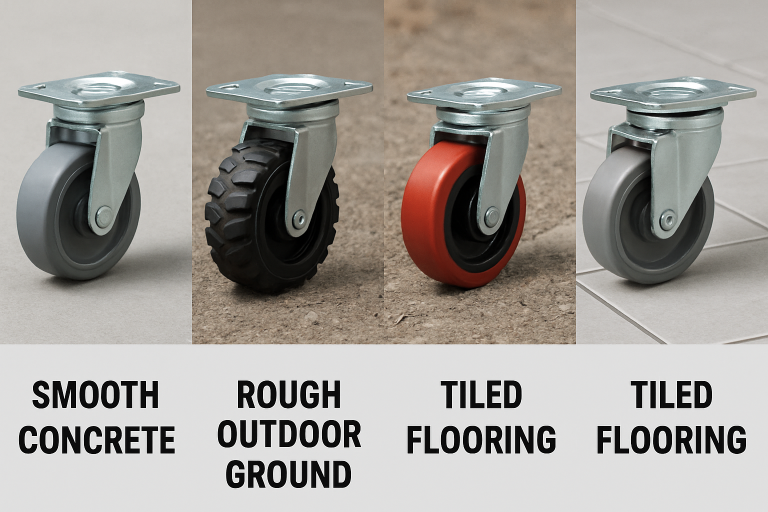
The flooring environment directly affects the required caster features. On smooth, hard floors, hard rubber or polyurethane wheels ensure effortless movement and reduced rolling resistance. For warehouses or spaces with tile, concrete, or finished wood, these materials will also help prevent floor damage. Conversely, for rough, uneven, or outdoor surfaces, softer and larger-diameter wheels—such as pneumatic or neoprene—are recommended. These absorb vibration and cushion loads, improving operator comfort while protecting transported items.
Regularly inspecting the condition of your floors and understanding the impact of cracks, debris, or tracks helps optimize caster performance. Choosing wheels matched to your specific surface conditions can avert unnecessary repairs and improve efficiency. As noted by Safety+Health Magazine, improper wheel selection often leads to surface wear and unpredictable cart movement.
Choosing the Right Wheel Material
The wheel material impacts several key factors, including equipment durability, workplace safety, and operating noise. Polyurethane wheels are a popular choice for balancing strength and non-marking characteristics, making them ideal for most indoor applications. Steel or cast-iron wheels are preferred in extreme heavy-duty or high-temperature scenarios, although they can scratch and damage delicate flooring. Nylon wheels are well-suited for environments exposed to moisture or chemicals, such as food processing or chemical storage, as they are non-corrosive and easy to clean.
Assess your use case: If your priority is noise reduction or protecting epoxy-coated floors, consider soft-tread options like thermoplastic rubber, which may be more suitable. High-capacity, shock-absorbing options are available for specialized requirements, offering additional protection and comfort for sensitive loads.
Considering Environmental Factors
Workplace environmental factors, including temperature extremes, humidity, and chemical exposure, should guide your selection process. Some materials—such as phenolic or metal wheels—handle high-heat areas near ovens or kilns. Stainless steel and other corrosion-resistant materials withstand moisture and chemicals encountered in food-service, laboratory, or outdoor settings. If casters will be exposed to oils, cleaning agents, or saline conditions, verify material compatibility for all caster components, not just the wheels.
Choosing casters rated to perform in your specific environment not only maximizes uptime and life span but can also prevent unexpected equipment malfunctions.
Evaluating Maneuverability Requirements
Mobility requirements vary depending on the workspace layout and typical tasks. Swivel casters enable tight turns and agile movement, which is essential in crowded or narrow areas. Rigid (fixed) casters, by contrast, deliver more stability and ease of control for long, straight routes. Most industrial applications benefit from a combination—placing two swivel and two rigid casters on carts or racks—to balance maneuverability and steering precision.
Casters can also be fitted with directional locks or brakes for enhanced control and stability. These options are essential in environments where heavy equipment must remain immobile at specific stations or during loading/unloading.
Prioritizing Maintenance and Durability
Well-maintained casters lead to safer workplaces and lower long-term costs. Cleaning wheels and bearings prevents the buildup of debris, which can cause misalignment or wheel locks. Regular inspections should identify problems such as flat spots, cracks, or worn bearings early on. Promptly replacing worn components reduces downtime and helps protect operators from ergonomic injury.
Consider casters featuring sealed bearings; these require less frequent maintenance and are better suited to dusty, wet, or contaminated environments. Tightening fasteners and mounting plates during scheduled maintenance rounds ensures reliable operation and prevents caster detachment incidents.
Enhancing Workplace Safety
Safe caster selection not only protects staff and equipment but also ensures compliance with workplace regulations and standards. Always select casters with sufficient load ratings—and opt for options with locking brakes to secure mobile equipment during stationary work. Specialty safety features, such as toe guards and impact-resistant body designs, can further reduce the risk of injury, especially in high-traffic or high-risk settings.
Employee education is an essential but often overlooked component; training staff to safely maneuver and inspect carts can reduce accident rates. Investing in high-quality casters is an investment in safety, stability, and future cost savings on repairs and injuries.
Conclusion
By adopting these best practices—matching load requirements, considering floor and environmental factors, selecting the appropriate wheel materials, and prioritizing maintenance—businesses can maximize operational efficiency and protect both assets and team members. Well-informed caster selection enhances workflow, reduces potential hazards, and ensures longevity of your investment. Reviewing your caster needs periodically, as facility layouts or operating conditions change, will help maintain safe and productive operations in the years to come.

FOLLOW ME ON SOCIAL MEDIA


No comments:
Post a Comment
I love reading and responding to comments but in order to get my reply you must ensure you are NOT a no-reply blogger. If you are, here are some quick steps to change that!
1. Go to the home page of your Blogger account.
2. Select the drop down beside your name on the top right corner and choose Blogger Profile.
3. Select Edit Profile at the top right.
4. Select the Show My Email Address box.
5. Hit Save Profile.